
Little moments of play · Around 9 months
Activities for your 9-month-old
Try partly hiding a toy, taking blocks out of a bowl, passing a toy, copying babble, or offering a choice of toys during supported floor play. Keep materials simple and let your baby repeat the part they enjoy.
By the CradleNote team
One idea is plenty
These are choices, not a daily checklist.
Let your baby lead
Awake, comfortable, and ready for a little play.
For everyone who cares
Easy to try. Lovely to share afterward.
A little inspiration for today
What feels right for this moment?
Start with one that catches your eye. The times are flexible; follow your baby’s interest and take a break whenever they need one.
5 of 5 ideas

Where Did It Go?
A partly hidden toy turns a familiar object into a shared little mystery.
You’ll needOne large toy and a cloth held by you
How to play
- Let your baby explore the toy where you can both see it.
- Partly hide it under the cloth while keeping a piece visible.
- Wait for a look or reach. Reveal it together if they want help.
“I can see a little bit. There it is!”
Make it easier
Cover only a corner of the toy.
What you might notice
Looking for the toy after part of it disappears.
Keep it comfortable. Keep the cloth in your hand and away from the baby’s face. Remove it after play; use a toy without choking hazards.
A little moment to remember · optional
Note what made the discovery funny: the reveal, your voice, or doing it again.
Create an account or sign in to save photos, videos, and notes.
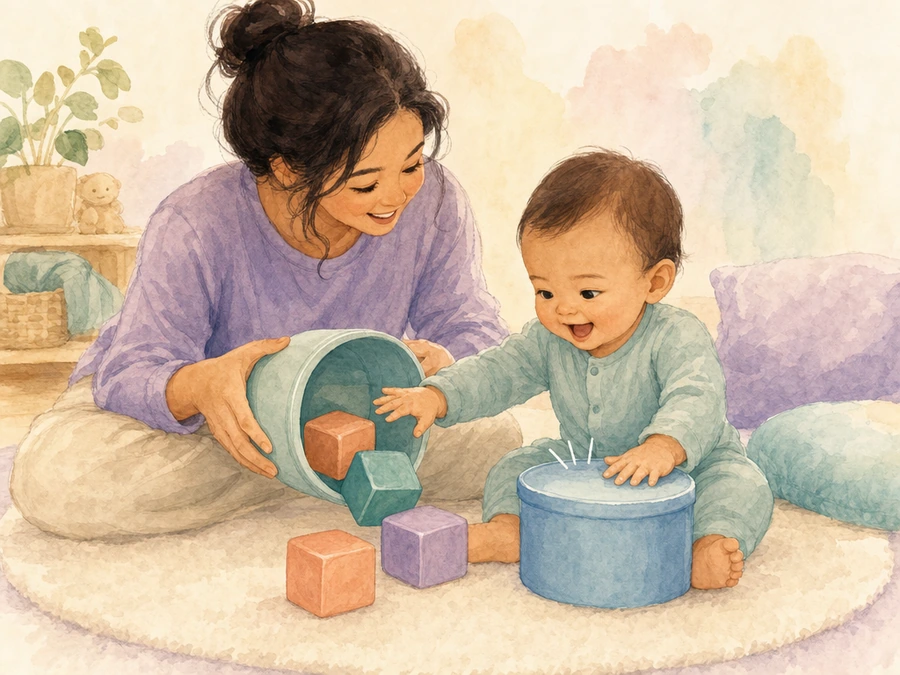
Dump-and-Fill Drum
Taking things out can be just as interesting as putting them back.
You’ll needA wide unbreakable bowl and three large blocks
How to play
- Sit together on the floor, giving your baby any support they need.
- Put the blocks in the bowl and tip them out slowly.
- Offer a block or let your baby explore the empty bowl. Repeat the part they enjoy.
“Out they come. Shall we put one in?”
Make it easier
Use one block and a bowl with a low rim.
What you might notice
Reaching into the bowl, releasing a block, or enjoying the sound.
Keep it comfortable. Use intact, age-appropriate objects with no small or loose parts. Stay within arm’s reach in a clear floor-level play space.
A little moment to remember · optional
Share whether taking out, putting in, or tapping was the favorite part.
Create an account or sign in to save photos, videos, and notes.

My Turn, Your Turn
An offered hand and a familiar toy make space for a tiny exchange.
You’ll needOne easy-grip baby-safe toy
How to play
- Offer the toy and let your baby explore it first.
- Hold out your hand and say “my turn,” without taking it away.
- Respond to a touch or an offered toy. Return it when they want another turn.
“Your turn. Thank you for showing me!”
Make it easier
Take turns touching the toy while your baby keeps holding it.
What you might notice
A look between you and the toy or a voluntary release.
Keep it comfortable. Use intact, age-appropriate objects with no small or loose parts. Stay within arm’s reach in a clear floor-level play space.
A little moment to remember · optional
Record the exchange in ordinary words; there is no need to score whether they shared.
Create an account or sign in to save photos, videos, and notes.

Babble Remix
Let your baby start the conversation, then answer with a familiar sound.
You’ll needYou and your voice
How to play
- Listen for a sound your baby is already enjoying.
- Repeat it gently and pause.
- Add a familiar word or a smile if they keep engaging. Follow their pace.
“Ba-ba! I heard you.”
Make it easier
Echo once, then simply listen.
What you might notice
A repeated sound, a new expression, or a pause that feels like a turn.
Keep it comfortable. Keep sounds gentle. Avoid correcting pronunciation or asking them to perform for a camera.
A little moment to remember · optional
Write the sound phonetically if you like. It does not need to be a word to be worth remembering.
Create an account or sign in to save photos, videos, and notes.
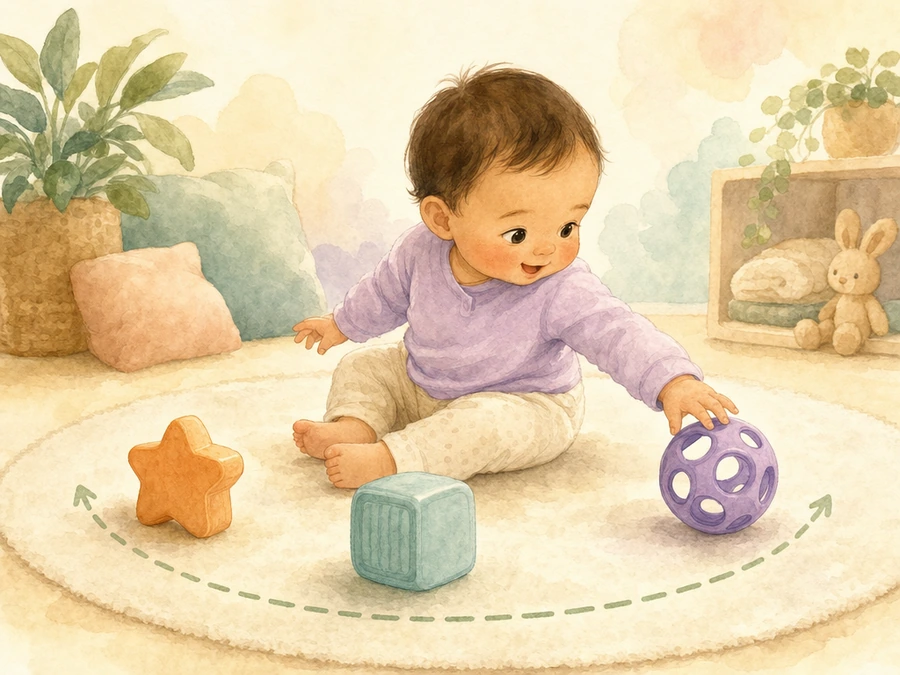
Toy Circle Sit-and-Turn
A small choice of toys invites your baby to decide where to look and reach.
You’ll needTwo or three large baby-safe toys
How to play
- Settle on the floor with the sitting support your baby needs.
- Place two toys close by in a small arc in front of them.
- Follow their choice. Bring a toy closer if reaching seems frustrating.
“You chose the blue one.”
Make it easier
Offer a single toy directly in front of them.
What you might notice
Their choice and how they explore it, rather than how far they can reach.
Keep it comfortable. Stay close enough to support balance. Never pull on arms, prop with unstable objects, or use a raised surface.
A little moment to remember · optional
Share their choice so the next caregiver can start with something familiar.
Create an account or sign in to save photos, videos, and notes.
Notice the little things, without making play a test.
Keep your observations separate from the game: what your baby looked for, which sound they repeated, or how they handled a toy. The nine-month milestone guide helps put those observations in context without turning each play session into a test.
Enjoying an activity doesn’t establish a milestone or assess development. Share concerns or any loss of skills with your child’s clinician. You can record what you saw today even if you don’t know when it first happened.
See the CDC’s 9-month developmental guideBring your people into the moment
A small note can make someone’s day.
A grandparent, nanny, or partner can pick up the same idea later. Share the activity and what your baby enjoyed. A photo or video is lovely when it’s practical, and a sentence counts too.
An example from a day together
“He wanted to tip the bowl out again and again. Putting the blocks back was my job today. Try the low bowl; it was easier to reach into.”
Something you tried. Something you noticed. Enough to bring the next person in.
A few things you might be wondering
How many activities does a 9-month-old need each day?
There is no daily checklist in this guide. Choose an idea that fits an ordinary awake moment. The suggested times are flexible; a brief exchange can be enough, and familiar play is welcome.
What if my baby doesn’t do what the activity describes?
Make the invitation simpler or stop. Looking, listening, touching, or watching you can be their way of joining in. An activity is not a developmental assessment; bring concerns or any loss of skills to your child’s clinician.
Can another caregiver try the same activity?
Yes. Share the setup, what held your baby’s attention, and when they wanted a break. Let the next caregiver find their own rhythm. A sentence about the experience is useful even without a photo.
A little more to explore
Developmental observations · By 9 months
9-month milestones: little observations worth sharing
Explore the CDC’s nine-month developmental checkpoint: expressions, babbling, gestures, object exploration, and sitting, with practical observation examples.
Read the guide
6 months · 5 play ideas
Activities for your 6-month-old
Five simple play ideas for your 6-month-old, with step-by-step instructions, everyday materials, and little moments to share with your care circle.
Read the guide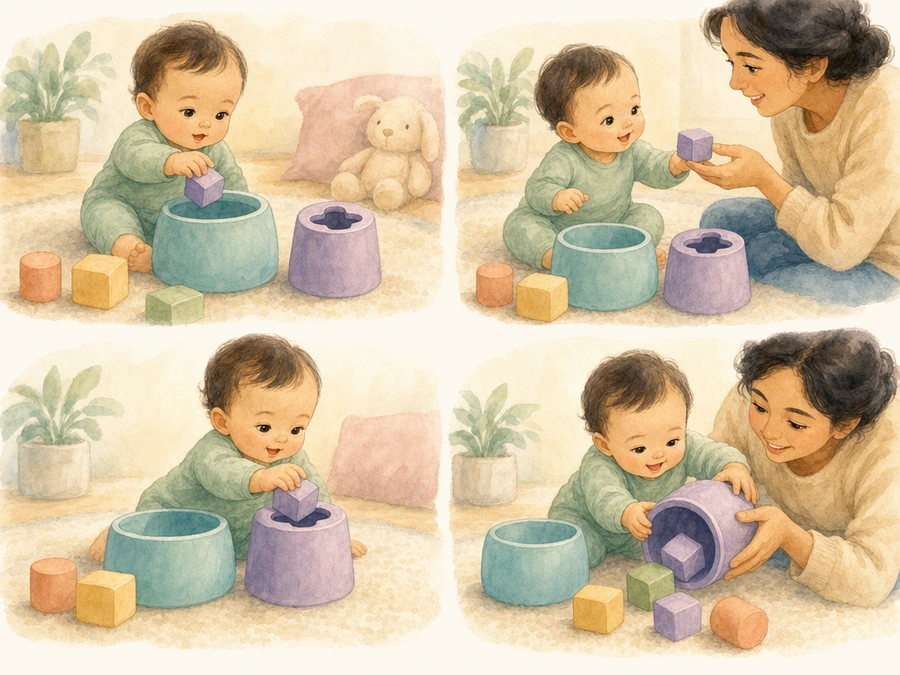
12 months · 5 play ideas
Activities for your 12-month-old
Five everyday play ideas for a 12-month-old: clapping rhymes, container play, shared looking, gestures, and picture books.
Read the guideKeep the little moments connected
More ideas for your baby. More moments for your circle.
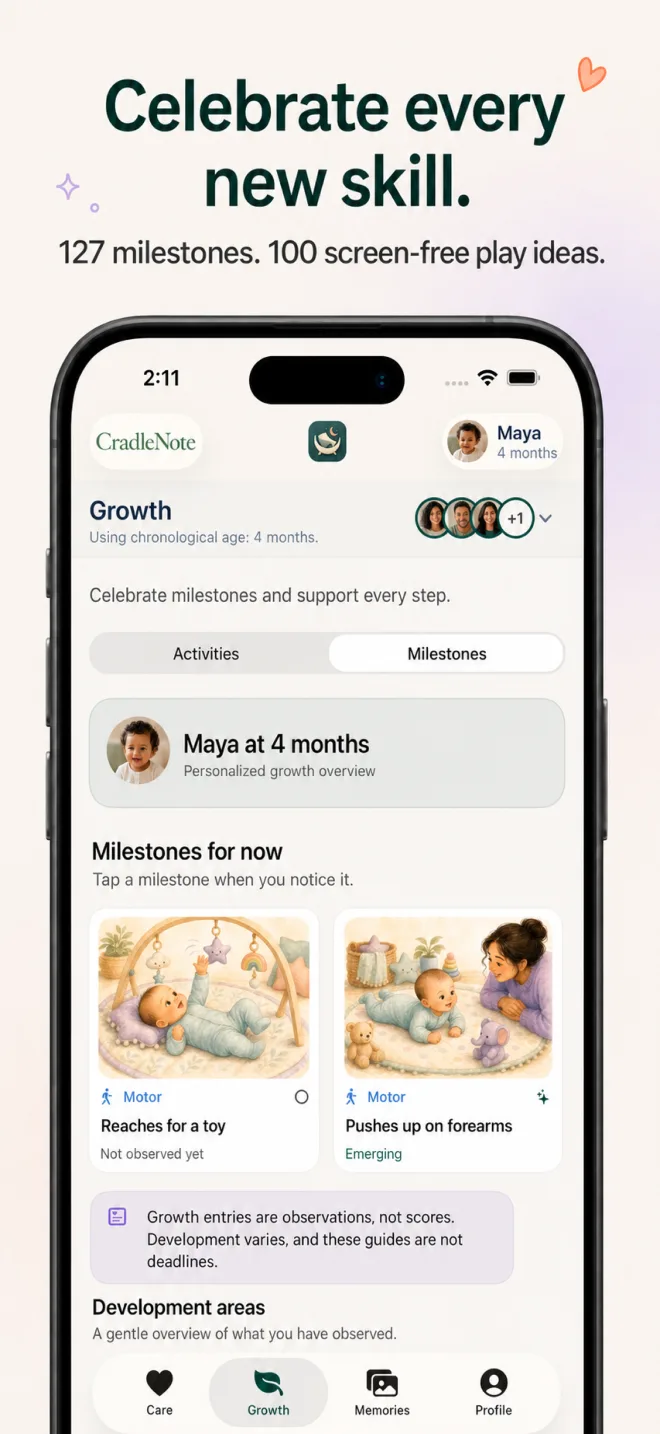
CradleNote brings age-appropriate activities, milestone observations, daily care, and private family memories into one shared place. Everyone you invite can contribute to the story.
Currently free to download and use. Account required. iPhone app requires iOS 17 or later.
Where these ideas come from
Written by the CradleNote team. We combine our Growth catalog with the sources below, adding practical play adaptations and illustrative caregiver notes. Sources inform the guidance; they do not endorse CradleNote. This is educational content, not an individual clinical assessment.
- CDC · Milestones by 9 months
The age checkpoint and everyday developmental observations.
- Harvard Center on the Developing Child · Serve and return
Background on responsive, back-and-forth interaction.
Written by the CradleNote team for everyday play and observation. This guide is not a developmental screening tool, a diagnosis, or a treatment plan. Illustrations show play ideas; follow the written safety guidance and your child’s individual needs.
Questions or a correction? Contact the CradleNote team.