
Developmental observations · By 6 months
6-month milestones: what to notice in everyday life
The six-month checkpoint includes familiar-person recognition, shared sounds, interest in mirrors and toys, and changes in movement. Use these observations to support a conversation with your child’s clinician, without turning play into a pass-or-fail test.
By the CradleNote team ·
Sources behind this guide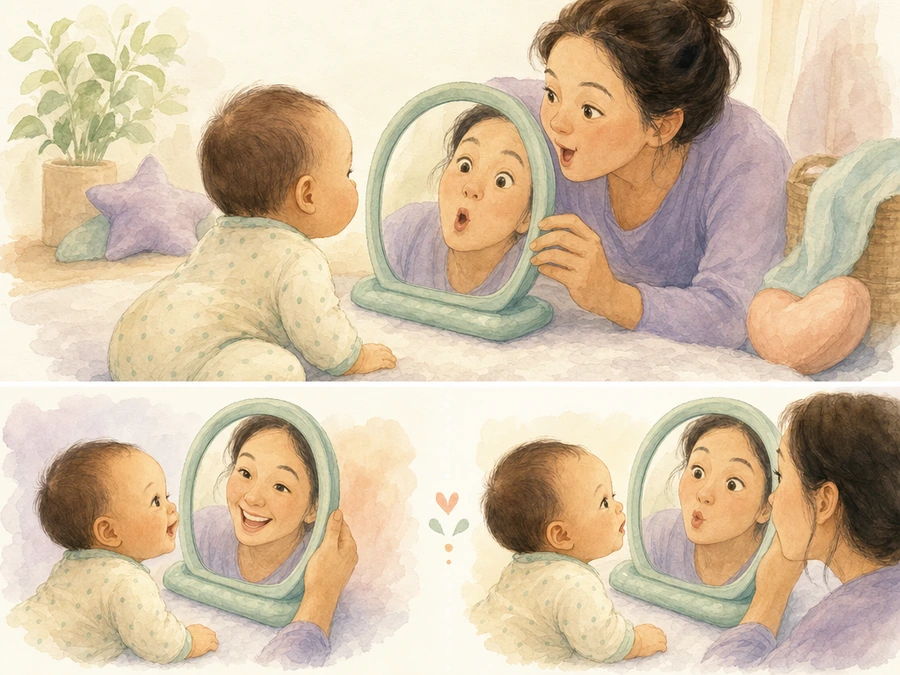
In this guide
What this checkpoint means
CDC milestones describe skills that at least 75% of children show by a given age. They support developmental monitoring and do not replace validated screening. The summary below is adapted from the CDC’s six-month checklist.
The six-month observations, grouped by area
Connection & feelings
- Responds to familiar people.
- Enjoys looking at a mirror reflection.
- Laughs during an interaction.
Sounds & communication
- Trades sounds with a caregiver.
- Makes raspberry sounds with the mouth.
- Makes squealing sounds.
Exploring & learning
- Explores objects by bringing them to the mouth.
- Reaches toward a desired toy.
- Closes the lips when finished with food.
Movement
- Rolls from tummy onto the back.
- Straightens the arms to push up during tummy play.
- Uses the hands for support while sitting.
Look for ordinary moments, not a performance
You might have a note from a sound game, a familiar person arriving, or a few minutes of floor play. Describe that particular moment instead of assuming the whole day looked the same.
You do not need to arrange every situation on the list. If something is unclear, keep it as a question for the clinician rather than repeatedly prompting your baby.
“During our song, I stopped after the first line. He squealed, I answered, and then he made another sound.”
Record an observation, even if it happened before
You can know what you saw today without knowing when it first happened. Keep those two ideas separate. A dated observation gives your family something concrete to remember and discuss.
Describe the action and the setting. If another caregiver saw it earlier, keep both observations. Neither person needs to prove they witnessed the first time.
“Today, during our floor play, I saw her reach toward the red toy twice. I’m not sure when she started doing this.”
How to record milestones when you don’t remember the first time
Bring questions to your child’s clinician
If your child is not meeting a milestone, loses a skill, or you have another concern, contact their clinician and ask about developmental screening. You do not need a perfect log or a video before asking for help.
Bring specific examples and your questions. Ask how prematurity or your child’s individual health needs affect which age guidance to use. These pages support everyday observation; they do not diagnose development or replace screening.
CDC guidance on developmental concerns and early intervention
Create an account or sign in to save photos, videos, and notes.
A few things you might be wondering
Does trying an activity mean the milestone is achieved?
No. An activity is a way to spend time together. A milestone describes an observed skill. Record the action you actually saw, and leave uncertainty in the note when needed.
Do I need a photo or video for every observation?
No. A brief description can preserve what happened. Take media only when it is practical and safe; you can also add an existing photo later. A camera should not turn an ordinary moment into a performance.
What if a grandparent or nanny noticed it first?
Ask them what they saw and when. Each caregiver can contribute their own perspective. Keep an approximate date labeled as approximate rather than inventing an exact first date.
A little more to explore
6 months · 5 play ideas
Activities for your 6-month-old
Five simple play ideas for your 6-month-old, with step-by-step instructions, everyday materials, and little moments to share with your care circle.
Read the guide
Developmental observations · By 9 months
9-month milestones: little observations worth sharing
Explore the CDC’s nine-month developmental checkpoint: expressions, babbling, gestures, object exploration, and sitting, with practical observation examples.
Read the guide
For your care circle · Notice, remember, share
How to record baby milestones when you missed the “first”
Keep useful milestone memories without guessing exact first dates. A simple approach for parents, grandparents, and nannies to share what they actually noticed.
Read the guideMeet CradleNote
One place for the people who care.
Share the day’s care, find activities to try together, and keep the memories your family makes along the way.
Currently free to download and use. Account required. iPhone app requires iOS 17 or later.
Where these ideas come from
Written by the CradleNote team. We combine our Growth catalog with the sources below, adding practical play adaptations and illustrative caregiver notes. Sources inform the guidance; they do not endorse CradleNote. This is educational content, not an individual clinical assessment.
- CDC · Milestones by 6 months
The age checkpoint and everyday developmental observations.
- CDC · Concerned about your child’s development?
Talking with a clinician and seeking developmental screening or early intervention.
Written by the CradleNote team for everyday play and observation. This guide is not a developmental screening tool, a diagnosis, or a treatment plan. Illustrations show play ideas; follow the written safety guidance and your child’s individual needs.
Questions or a correction? Contact the CradleNote team.